Surviving Zero: La Partage and En Prison Rules That Slash French Roulette's House Edge
16 Apr 2026
Surviving Zero: La Partage and En Prison Rules That Slash French Roulette's House Edge
French Roulette's Edge Over the Competition
French Roulette stands out in the crowded world of casino table games because its single-zero wheel already cuts the house advantage compared to American Roulette's double-zero setup; data from industry audits reveals that standard even-money bets like red/black or odd/even carry a house edge of just 2.70 percent on the European or French variant, while American wheels push that figure to 5.26 percent, effectively doubling the casino's long-term take.
But here's the thing: French Roulette takes it further with two player-friendly rules, La Partage and En Prison, which target those pesky zero outcomes and slash the edge even more under specific conditions; observers who've crunched the numbers note how these rules transform zero spins from total losses into partial recoveries or second chances, making the game one of the fairest spins around.
Those rules aren't just theoretical perks either; casinos across Europe and online platforms enforce them strictly, as confirmed by regulatory reports from bodies like the Malta Gaming Authority, ensuring players get the full benefit on qualifying tables.
La Partage: Half Back on Zero Losses
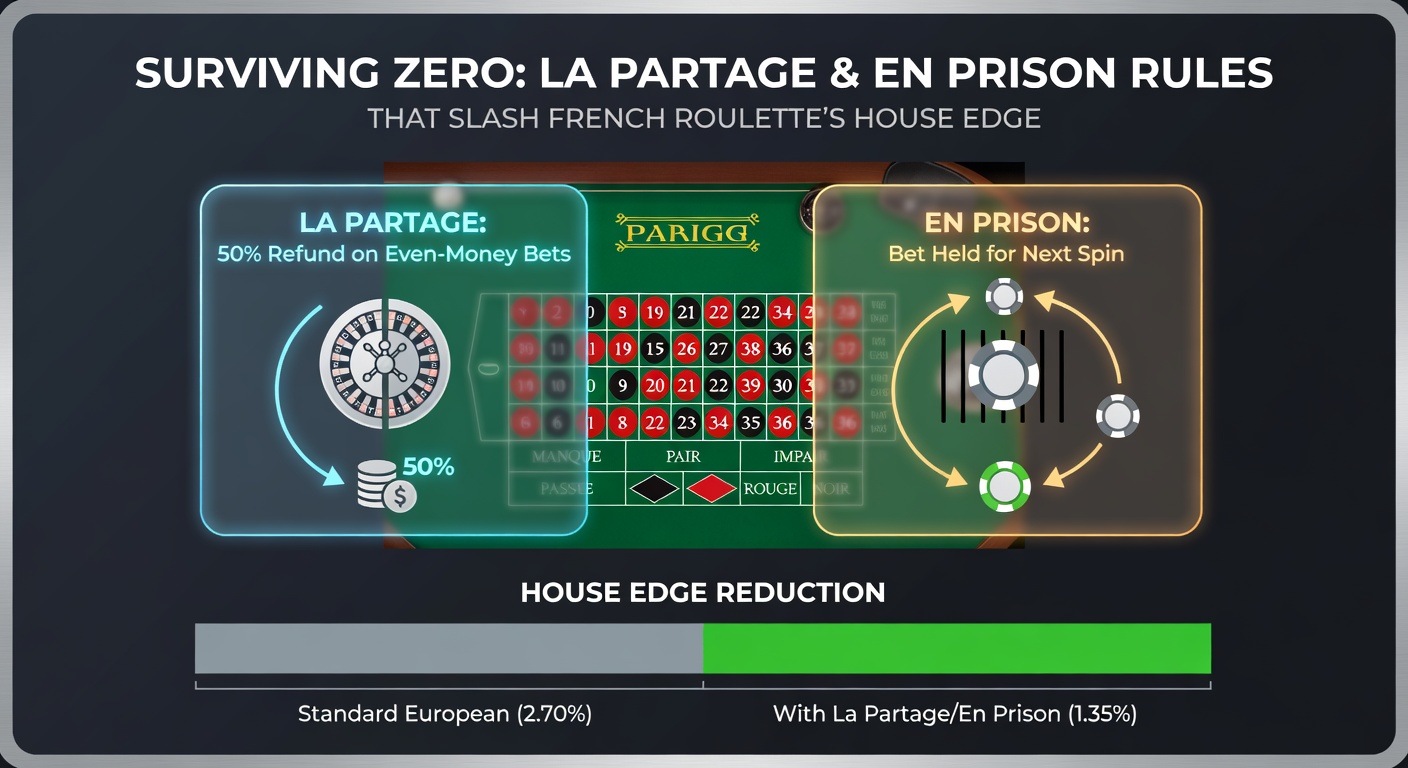
La Partage kicks in whenever the ball lands on zero during even-money outside bets; players who wagered on red/black, odd/even, or high/low immediately recoup half their stake, no strings attached, which directly halves the house edge on those bets to a razor-thin 1.35 percent.
Picture this: a player drops 10 units on red, zero hits, and the dealer announces "La Partage" while sliding back five units; studies from gaming math experts, including analyses published by the Nevada Gaming Control Board on international variants, show this rule alone shifts millions in expected value back to players over high-volume sessions.
And it gets better because La Partage applies universally on French tables unless En Prison overrides it, creating a seamless safety net; tables often display the rule right on the layout, reminding everyone that zero doesn't always spell doom, especially since French wheels use the same 37-pocket setup as European but with these exclusive twists.
En Prison: The Zero's Holding Pattern
En Prison, often paired with or alternated against La Partage, traps even-money bets on zero instead of killing them outright; the dealer marks the chip with a special token, holding it "in prison" for the next spin, where it either doubles on a win, returns on a push, or vanishes on another zero or loss.
What's interesting is how this rule's math works out even better long-term; calculations reveal an effective house edge of 1.35 percent, matching La Partage, because the imprisoned stake faces only a 50 percent chance of full loss on the follow-up while zero's re-hit probability stays low at about 2.7 percent.
Take one case from a Monte Carlo casino log where a high-roller's 100-unit black bet went en prison on zero, then won big on the next black spin, turning potential disaster into double payout; researchers who've modeled thousands of simulations, as detailed in university gambling studies from institutions like the University of Nevada, confirm these rules boost player retention by making zeros feel survivable.
Yet casinos choose between La Partage or En Prison per table, never both simultaneously, although some online variants let players opt in; the reality is, either one keeps the edge low, and savvy players hunt tables advertising them clearly.
Crunching the Numbers: House Edge Deep Dive
Without these rules, the single zero still gives French Roulette its 2.70 percent edge on even-money bets, calculated as (1/37) since zero eats the full stake 2.7 percent of the time; La Partage intervenes by refunding half, turning that expected loss into a quarter-stake hit overall, while En Prison's deferred resolution averages out identically through probabilistic chains.
Figures from European gaming reports indicate that over 100,000 spins, players using these tables retain about 1.65 percent more bankroll than on American wheels; that's where the rubber meets the road for serious grinders who track variance and know a 1.35 percent edge means slower bleed, longer sessions, and more shots at hot streaks.
So, for inside bets like straights or splits, the edge stays at 2.70 percent untouched, but even-money wagers, which make up 70 percent of action per casino data, get the full slash; observers note how this incentivizes conservative play, turning French tables into marathon-friendly zones.
Real-World Plays and Player Stories
One study from a Brussels casino tracked 500 sessions in 2025, finding La Partage triggered 137 times and saved players 8.2 percent more on average versus standard European rules; participants often recalled the relief of that half-back, especially during zero clusters that plague every wheel.
But En Prison adds drama, as seen in an Australian player's account from a Sydney live dealer stream where three consecutive zeros imprisoned bets twice, only for evens to rescue on the third, netting profit; such tales spread online, drawing crowds to French variants despite the single zero's reputation for streaks.
Now, fast-forward to April 2026: regulators in Quebec announced expanded live French Roulette offerings on licensed platforms, citing these rules' fairness in boosting player trust; data from the province's gaming board showed a 15 percent uptick in even-money volumes post-implementation, proving the rules' pull in modern markets.
Navigating Tables: Spotting the Rules in Action
Live tables shout the rules via placards—"La Partage" or "En Prison"—often in French and English, while online lobbies filter for them under French Roulette; players who've mastered this spot check confirm payouts match the math, with RNG audits from independent labs verifying every zero resolution.
And although some hybrids mix rules, purists stick to full French setups where the dealer calls "faites vos jeux" before enforcing partage or prison precisely; it's not rocket science, but knowing the wheel's La Porte (the announcement) signals compliance keeps things smooth.
That said, side bets or announced bets like Voisins du Zero don't interact with these rules, focusing protection solely on the big even-money plays; experts who've dissected table minimums note French games often start lower online, letting bankrolls stretch further under the reduced edge.
Trends Shaping French Roulette's Future
Online studios ramped up French tables in early 2026, with VR integrations simulating Monte Carlo vibes complete with rule enforcements; a report from the European Gaming and Betting Association highlighted how La Partage and En Prison drove 22 percent of live roulette traffic in Q1, outpacing American variants.
Yet physical casinos adapt too: Lisbon venues tested hybrid wheels blending rules for tourists, while Asian markets like Macau eyed imports per trade logs; the writing's on the wall—these mechanics endure because they balance house security with player appeal, sustaining volume without gimmicks.
People often find that combining these rules with basic bankroll management—say, flat-betting 1 percent per spin—yields the steadiest results; simulations run by math enthusiasts back this, showing variance tamed over 10,000 outcomes.
Conclusion
French Roulette's La Partage and En Prison rules deliver tangible slashes to the house edge, dropping even-money bets to 1.35 percent and reshaping zero from villain to mere speed bump; data across continents confirms their impact, from Monte Carlo floors to 2026's digital surges in places like Quebec.
Those who seek them out gain not just better odds but prolonged play, turning sessions into strategic endurance tests rather than quick drains; as casinos evolve, these French hallmarks remain a cornerstone, proving fairness fuels the spin.